Pages

Được tạo bởi Blogger.
Hiển thị các bài đăng có nhãn Paul Julian. Hiển thị tất cả bài đăng

Thứ Sáu, 24 tháng 7, 2015

Paul Julian Rides Again

“Bugs Bunny Rides Again” is about as perfect a cartoon as Friz Freleng ever made. It’s packed with funny scenes and dialogue from start to finish.

Here are some of Paul Julian’s backgrounds. What a shame the full, long paintings don’t exist any more. There’s a beautiful interior of the saloon that’s quickly panned (the frame with the piano below part of it) I’d love to study.


Is that “Slosburg Harness”? Any idea who’s being referenced? How about Josiah Cheever?


P.J. (Paul Julian) to the left of Bugs. Mike Maltese, 1370, Friz Freleng and Tedd Pierce to the right. 1370? Virgil Ross is the animator.


This town ain’t big enough for the two of us! It ain’t?


Now is it big enough?


Ken Champin reference.


Hawley Pratt (feed), Bill Melendez (bulqueria) and Gerry Chiniquy (blacksmith) references. Sam’s expression as he dances off, stage right, is an all-time classic.


Manny Perez doesn’t rate a background reference. Neither does Virgil, it seems.

Thứ Hai, 23 tháng 2, 2015

Hidden Jones and Freleng

Friz Freleng’s “All Abir-r-r-d” doesn’t just have references to staff members in the opening (see this post) but during the baggage car scenes.


Here’s a parcel sent by Mel Blanc to “Fred Fraling.” I can only imagine the variety of ways people mispronounced Friz Freleng’s name. The cartoon studio was at 1351 North Van Ness.


Here’s a crate for another resident of 1351 N. Van Ness—one C. Martin Jones. I suspect you know which cartoon director he is.


The trunk is on its way to Friz Freleng of Pratt Falls, Wisconsin. There may not be a Pratt Falls, but there is a Hawley Pratt who laid out this cartoon.


The label on the green case reads “Tedd Pierce.” Pierce wrote the cartoon. The rest of the label isn’t very readable but it says “Low” and “Nevada.” I presume it’s a Las Vegas/Low Wages gag. I can’t read the label on the red hat box.


“Anyone can ? this one for free”.


Gower Gulch was the nickname of the area at Gower and Sunset, not all that far from the Warner Bros. cartoon studio. At one time, it’s where cowboys hung out to get work as extras in silent westerns.

The inside jokes are again from the brush of background artist Paul Julian.

Thứ Hai, 20 tháng 10, 2014

Hollywood and Vine, 1946

The corner of Hollywood and Vine greets viewers at the opening of “Hollywood Daffy” (1946). A pan down from the street sign shows the inevitable Hollywood wolves. Note the subtle shadow against the yellow Hollywood Plaza Hotel, indicated by the diagonal colour change on the windows (the hotel really was at Hollywood and Vine; it has been converted into a retirement home).

The backgrounds in this cartoon are by Paul Julian from layouts by Hawley Pratt. Let’s look at a couple of other backgrounds in the opening scene where Daffy arrives in Hollywood by bus. Somewhat out of character, Julian doesn’t work the names of Freleng unit members into the artwork this time. However, it looks like Grauman’s Chinese Theatre is in the distance in one of the drawings.

Thứ Sáu, 5 tháng 9, 2014

An Upper Berth in the Ross Car

Here’s another one of Paul Julian’s inside gags that caught me by surprise. It’s from “All Abir-r-r-d” (released 1949). You can barely catch it in the frames below; I imagine it would be easier on a Blu-Ray version.

Julian loved hiding names of the members of Friz Freleng’s unit in the background. That happens in the opening animation in the titles of this cartoon. If you can see this first frame well enough, you’ll notice the names on the two rail cars. One is “Ross” and the other in “Champin.” Virgil Ross and Ken Champin were animators on this short.


And in this shot, the cars are labelled “Frizby” and “Hawley.” Friz Freleng directed the short and Hawley Pratt laid it out (I think the next car simply says “Baggage”).


As you can see, Art Davis and Emery Hawkins also animated this cartoon. Hawkins had been in the Davis unit before it was disbanded and Artie moved over to Friz’s unit.

Thứ Hai, 16 tháng 12, 2013

Hawley Says Drink It!

Another staff reference from background artist Paul Julian in a Warners’ cartoon, this time in “Kit For Cat,” released in 1948. Sylvester picks through the garbage in the opening scene and tosses a kitten into a can wherein rests an empty liquor bottle.


It’s another reference to Hawley Pratt, who was the layout artist on this cartoon.

Thứ Sáu, 15 tháng 11, 2013

Artists in the Background

Paul Julian liked inserting names of staff members in backgrounds of a number of cartoons he made for Friz Freleng’s unit at Warners, and a really good example is “Ballot Box Bunny” (released 1951).


The first one comes about a minute and a half into the cartoon. There’s animator Virgil Ross. And you’ll remember Fearless Freep from Freleng’s “High Diving Hare” (released 1949). Freep wasn’t a person. Bob Clampett told animation writer Jim Korkis: “Freep is a word we used at Warners which meant a cross between a Freak and a Creep.”


Maybe someone has some insight into who Hinkle and Ames were. The name “M. Hinkle” makes a background appearance in Chuck Jones’ great cartoon “Chow Hound” (released 1951).


Animator Manny Perez.


On the statue’s plaque are the following: Warren Batchelder (Ross’ assistant animator), Ken Champin (animator), Sid Farren (assistant animator), Julian, Sam Nicholson (assistant animator), Perez, Hawley Pratt (layout artist) and Ross. Art Davis also animated on this cartoon, but I haven’t spotted his name anywhere.


A building to the right is named “Frizby” for Friz Freleng. In front of that is a welding shop with writer Warren Foster’s name.


Paul Julian owns a yard something-or-other store.


Finally, a parade passes at the intersection of Colfax Avenue and Kling Street. Such an address actually exists in North Hollywood. It’s not the site of the Warners’ cartoon studio; it’s a residential area. Who lived there at the time this cartoon was made, I don’t know.

Thứ Hai, 9 tháng 9, 2013

The Hidden Friz

It isn’t easy for a director to appear in his own cartoons, unless there’s some live action footage. But Friz Freleng showed up in a few shorts, sometimes as a character and sometimes in the background.

Paul Julian inserted Friz in the 1951 release “Putty Tat Trouble,” featuring Sylvester and an orange cat rummaging around a basement after Tweety. You can see Friz in a background portrait. Evidently, the homeowner didn’t like it and chucked it in the basement.


There’s another reference to the studio’s senior director on a box. And you thought Jell-O was number one.


Warners wasn’t the only studio to feature these in-jokes and Julian wasn’t the only artist who painted them, but he’s probably associated with them more than anyone else at the studio. And it’s fun when you stumble onto them.

Thứ Hai, 8 tháng 10, 2012

High Diving Julian

Try this—picture the great cartoon “High Diving Hare” (1949) with a score by Bill Lava, backgrounds by Tom O’Loughlin and those late-‘50s box-head character designs that Hawley Pratt came up with. Doesn’t work as well, does it? It shows you how everything and everyone had to mesh to make a Warner Bros. cartoon, and how moving to a more representational style of drawing after the ‘40s didn’t make things as entertaining on the screen in some cases.

Friz Freleng played a winning hand with the early Bugs Bunny/Yosemite Sam cartoons. “Bugs Bunny Rides Again” may be my favourite, but this is among the tops. It features subtle but expressive animation, Friz’s perfect gag timing, a right amount of silliness and, of course, Sam always explodes and Bugs always wins. Oh, and Paul Julian provided great sets. I’ve always liked how he uses colour changes to simulates highlights.

I wish the opening background that’s panned was in someone’s collection and on-line. Here it is in three frames.


Julian plants a reference to Friz in the last one. Frizby is a magician appearing on the bill. Some more backgrounds.


And one background is used as a gag. Sam falls for it. Literally.


The cartoon was released in April 1949 but still playing in theatres as late as January 1951. Here it is on one of those Saturday matinees for kids. One Bugs and three Terrytoons. You remember The 3 Magpies, don’t you? And, yes, people couldn’t spell in 1950, either.

If you want to know more about the animators on this one, drop by HERE.

Thứ Ba, 17 tháng 7, 2012

Hot Spot Backgrounds

Tex Avery had a great influence on the theatrical animation business, but it seems the first thing he did that everyone copied was phoney travelogues. A lot of them, even by Avery himself, weren’t that hot.

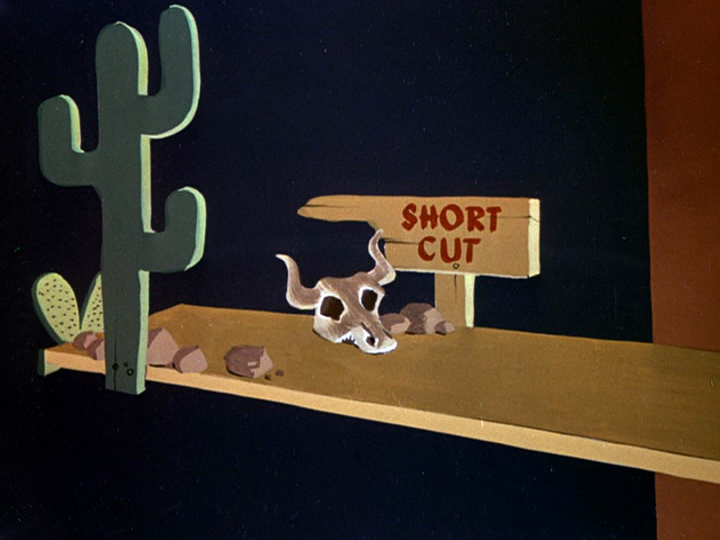
Even the war-time Snafu series for the Army-Navy Screen Magazine used the travelogue format once, in “Hot Spots” (1945). The backgrounds look like the work of Paul Julian and, judging by this post at Thad Komorowski’s web site, the layouts are by Hawley Pratt.


Even the final gag owes something to Avery’s “Land of the Midnight Fun” polar bear bit. The gags actually don’t centre around Snafu at all, and maybe that’s why this cartoon isn’t as enjoyable as the others in the series.

If the voice of the Devil isn’t Hal Peary, it’s the best impression of Peary this side of Willard Waterman (and it doesn’t sound like Dick Nelson’s impression of Peary to me).
 

Blogger news

Blogroll

About